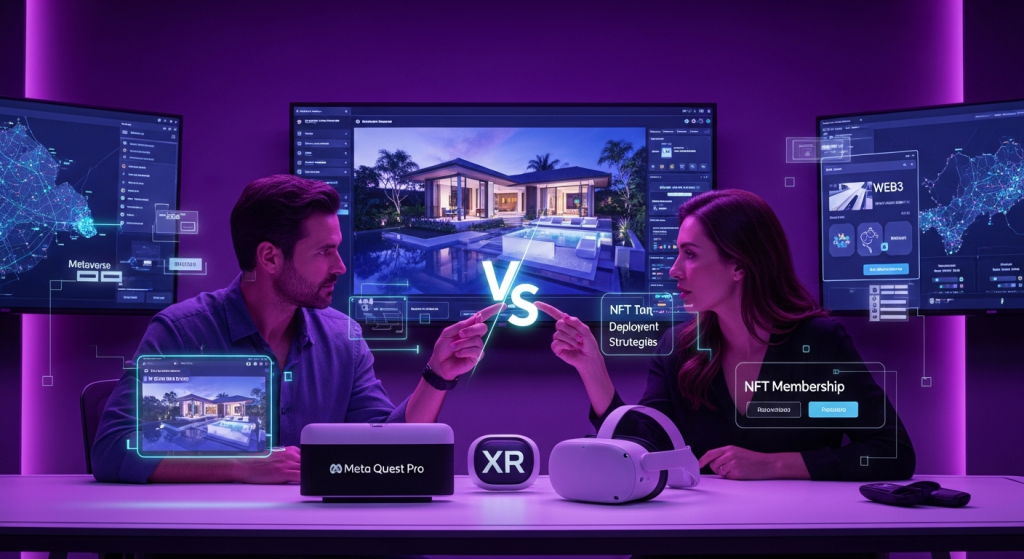
The Bali Metaverse represents a pioneering digital twin platform, mirroring Bali’s luxury tourism and real estate within a Web3 framework. It offers a tangible alternative to generic virtual worlds by providing high-fidelity, geographically specific digital replicas for property development, immersive tourism, and a robust digital nomad ecosystem, all anchored by Singapore’s Web3 regulatory clarity.
- Precision Digital Twins: Experience accurate, detailed virtual representations of properties and landscapes in Pecatu, Bukit, and Canggu.
- Luxury Concierge Integration: Seamlessly blend virtual exploration with real-world luxury bookings and personalized services.
- Web3 Economic Hub: Leverage a secure environment for NFT-backed real estate, fractional ownership, and creator economy opportunities.
The Indian Ocean breeze carries whispers of a new frontier, where Bali’s iconic landscapes meet the boundless potential of Web3. Here, pixels coalesce into properties, and data streams into destinations. The Bali Metaverse emerges not as a generic virtual world, but as a meticulously crafted digital twin, offering a distinct proposition in the expanding universe of extended reality.
The Digital Twin Advantage: Replicating Reality with Precision
Most metaverse platforms offer open, often abstract, digital canvases where users construct environments from basic primitives. Consider Decentraland or The Sandbox; their appeal lies in user-generated content and a blocky, stylized aesthetic. Land parcels are sold, and structures are built, but rarely do these virtual spaces reflect real-world locations with topographical accuracy or architectural fidelity. A 2023 report indicated that the average polygon count for an avatar in Decentraland is around 1,000, starkly contrasting with the millions of polygons required for photorealistic architectural renderings in the Bali Metaverse.
The Bali Metaverse, however, operates on a different principle: the digital twin. This approach meticulously recreates specific locations such as the luxury enclaves of Pecatu and Bukit, or the vibrant digital nomad hub of Canggu, using LiDAR scanning and photogrammetry. Property developers can showcase their unbuilt villas in Bukit, offering virtual tours with 1:1 scale accuracy, years before physical completion. For instance, a proposed 500-square-meter villa in Pecatu, valued at US$2.5 million, can be explored virtually, from its infinity pool overlooking the Indian Ocean to its custom-designed interiors, allowing potential buyers in Singapore or London to experience it as if they were physically present. This level of detail is critical for high-value real estate transactions, where trust and visual clarity are paramount. Traditional platforms lack this precision, often resulting in less convincing portrayals that require significant imaginative leaps from the user. The distinction is clear: a generic metaverse sells a concept; the Bali Metaverse sells a verifiable, digital replica of tangible asset value.
Luxury Concierge & Immersive Tourism: Beyond Avatars
Generic metaverse platforms like Meta Horizon Worlds or Spatial primarily focus on social interaction and casual gaming. Users meet as avatars, attend virtual concerts, or participate in rudimentary meetings. While engaging, these experiences rarely extend beyond the digital realm or integrate with high-end physical services. There is no direct pathway to book a private chef for a villa in Seminyak, or arrange a bespoke surf lesson at Uluwatu, from within these environments. The average virtual event ticket on such platforms might cost US$10-50, but it does not translate into real-world luxury services.
The Bali Metaverse redefines luxury tourism by linking virtual exploration with real-world concierge services. Imagine a MICE delegation exploring a digital twin of a five-star resort in Nusa Dua, complete with detailed conference facilities and event spaces. From this virtual environment, delegates can directly interface with a human concierge avatar to schedule physical site visits, book rooms for 200 attendees, or arrange bespoke cultural excursions to the UNESCO-listed Subak irrigation system. This integration transforms passive viewing into active planning. For example, a virtual tour of the Mandapa, a Ritz-Carlton Reserve in Ubud, allows future guests to customize their stay, selecting specific villa layouts or wellness treatments, with real-time availability and pricing. This seamless transition from virtual discovery to physical booking, powered by Web3 smart contracts for transparency and efficiency, is absent in general metaverse offerings. It elevates the digital experience from mere entertainment to a functional, high-value service platform, catering to discerning travelers and property investors who expect precision and convenience. This is not just about meeting avatars; it is about facilitating real-world luxury experiences with digital precision.
Web3 Ecosystem & Regulatory Clarity: Singapore’s Gateway to Bali
The broader Web3 landscape, encompassing various metaverse projects, often operates in a regulatory grey area, with fluctuating legal frameworks across different jurisdictions. Many platforms are decentralized to the point of lacking a clear legal entity, which can deter institutional investment and sophisticated users. While some projects have established foundations in crypto-friendly nations, the overall environment can be fragmented and unpredictable. A recent study by Chainalysis in 2023 highlighted the diverse and often conflicting regulatory stances on digital assets globally, creating uncertainty for large-scale operations.
The Bali Metaverse offers a distinct advantage through its strategic connection to Singapore, a recognized global Web3 hub. Singapore’s Monetary Authority of Singapore (MAS) provides one of the world’s most robust and clear regulatory frameworks for digital assets and financial services. This provides a stable and credible foundation for the Bali Metaverse‘s operations, particularly for NFT membership, asset tokenization, and digital finance. For instance, property developers considering tokenizing a US$10 million resort in Canggu can leverage Singapore’s legal clarity for fractional ownership and security token offerings. Concurrently, Bali itself is actively fostering a digital nomad ecosystem, including initiatives like the “Golden Visa” launched in 2023, attracting Web3 founders and talent. This dual-hub strategy—Singapore for regulatory and financial robustness, Bali for creative and operational vibrancy—creates a unique synergy. It provides a secure, compliant environment for Web3 innovation, a stark contrast to the often speculative and less regulated environments of other metaverse projects. This institutional backing and clear legal roadmap build trust, essential for attracting serious investors and establishing long-term viability in the digital economy.
Real Estate & Asset Tokenization: Tangible Value in the Virtual
In many generic metaverses, “land” is a purely digital asset, often speculative, with value derived from scarcity and user demand within that specific virtual world. Owning a parcel in The Sandbox, for example, grants digital rights within that platform but typically holds no direct, verifiable link to real-world assets or utility beyond the digital realm. Prices fluctuate wildly, driven by hype cycles rather than underlying economic fundamentals. A plot of virtual land might trade for US$10,000 one month and US$1,000 the next, with no connection to physical property markets.
The Bali Metaverse fundamentally redefines this by focusing on digital twins of real-world Bali properties and facilitating asset tokenization. Here, NFTs are not merely collectibles; they can represent fractional ownership of actual villas, resorts, or commercial spaces in Pecatu, Bukit, or Canggu. A developer of a luxury villa complex on the Bukit Peninsula, with a total value of US$50 million, can offer verified digital twins for virtual tours and tokenized fractional ownership through secure Web3 contracts. This allows a broader pool of investors to participate in Bali’s buoyant real estate market, which saw a 7.5% year-on-year growth in luxury property values in 2022. The virtual asset directly correlates to a physical asset, providing tangible value and a clear legal framework for ownership. This model reduces barriers to entry for investors, offers liquidity to property owners, and enables innovative financing structures. The Bali Metaverse is not selling speculative virtual land; it is offering a transparent, verifiable, and accessible pathway to engage with Bali’s high-value physical real estate, bridging the gap between digital ownership and tangible assets. This transforms the digital realm from a separate economy into an extension of the real-world market.
Creator Economy & Cultural Preservation: Empowering Bali’s Artisans
General metaverse platforms often feature a creator economy, but it is typically broad and lacks specific geographical or cultural anchoring. Artists and developers from anywhere can create digital assets, avatars, or experiences, selling them on a global marketplace. While this offers opportunities, it can also lead to a dilution of unique cultural identities and a focus on generic, widely appealing content. The revenue models are often platform-centric, with a significant cut going to the metaverse provider. For instance, an independent artist might earn 70% of sales after platform fees on a large marketplace.
The Bali Metaverse cultivates a creator economy deeply rooted in Balinese culture and local talent. It provides a platform for Balinese artists, designers, and cultural practitioners to create and monetize unique digital assets, from NFT art inspired by traditional Balinese iconography to virtual fashion reflecting local textiles, or immersive XR experiences showcasing sacred sites like Tirta Empul. This directly empowers the local community, fostering economic opportunities that celebrate and preserve Bali’s rich heritage. The Web3 framework ensures transparent royalties and direct payments to creators, bypassing traditional intermediaries. For example, a Balinese artist selling a digital painting as an NFT could retain 95% of the sale value, significantly higher than traditional art markets. This approach also extends to virtual tourism, allowing local guides to offer immersive digital tours of sites like the Jatiluwih Rice Terraces, a UNESCO World Heritage site since 2012, to a global audience. The Culture of Bali becomes a central pillar of its digital economy, not just a backdrop. This contrasts sharply with generic metaverses where cultural representation might be superficial or commodified without direct benefit to source communities. The Bali Metaverse prioritizes authentic representation and equitable economic empowerment for Bali’s unique creative ecosystem.
XR Immersion & Accessibility: Bridging Physical and Digital
Many metaverse platforms are either heavily reliant on specific, often expensive, VR hardware (e.g., Meta Quest 3, Apple Vision Pro) or are limited to desktop browser experiences that lack true immersion. This creates barriers to entry, segmenting the audience by device ownership and technical capability. While VR adoption is growing, with an estimated 43.2 million VR users in the US by 2024, it is still not ubiquitous. Browser-based metaverses, while accessible, often compromise on visual fidelity and interactive depth, leading to a less engaging experience.
The Bali Metaverse is engineered for multi-platform accessibility and deep XR immersion, bridging the physical and digital with innovative technology. It offers optimized experiences across a spectrum of devices: high-fidelity VR for property developers conducting virtual walk-throughs of a new resort in Canggu; augmented reality (AR) overlays for tourists exploring physical locations in Ubud, enhancing their real-world views with digital information about local attractions or historical facts; and robust web-based access for broader audiences. This ensures that the experience is not confined to a single hardware ecosystem. For instance, a hotel group could offer a potential guest an AR tour of their physical hotel lobby, revealing digital menus or event schedules through their smartphone camera. This hybrid approach caters to diverse user needs and technological readiness. The focus is on seamless transitions between the physical world and its digital twin, enriching real-world travel with digital layers, rather than replacing it. This strategy maximizes reach and utility, distinguishing the Bali Metaverse as a practical, forward-thinking platform for tourism and real estate, rather than a niche virtual playground. For more on Indonesia’s tourism, visit indonesia.travel.
The Bali Metaverse offers a tangible future where digital innovation enhances, rather than replaces, the allure of physical Bali. It is a strategic platform for luxury tourism, real estate development, and a thriving Web3 economy, built on precision, purpose, and a clear vision. Explore how this unique ecosystem can elevate your projects and experiences. Discover the future of Bali, today.